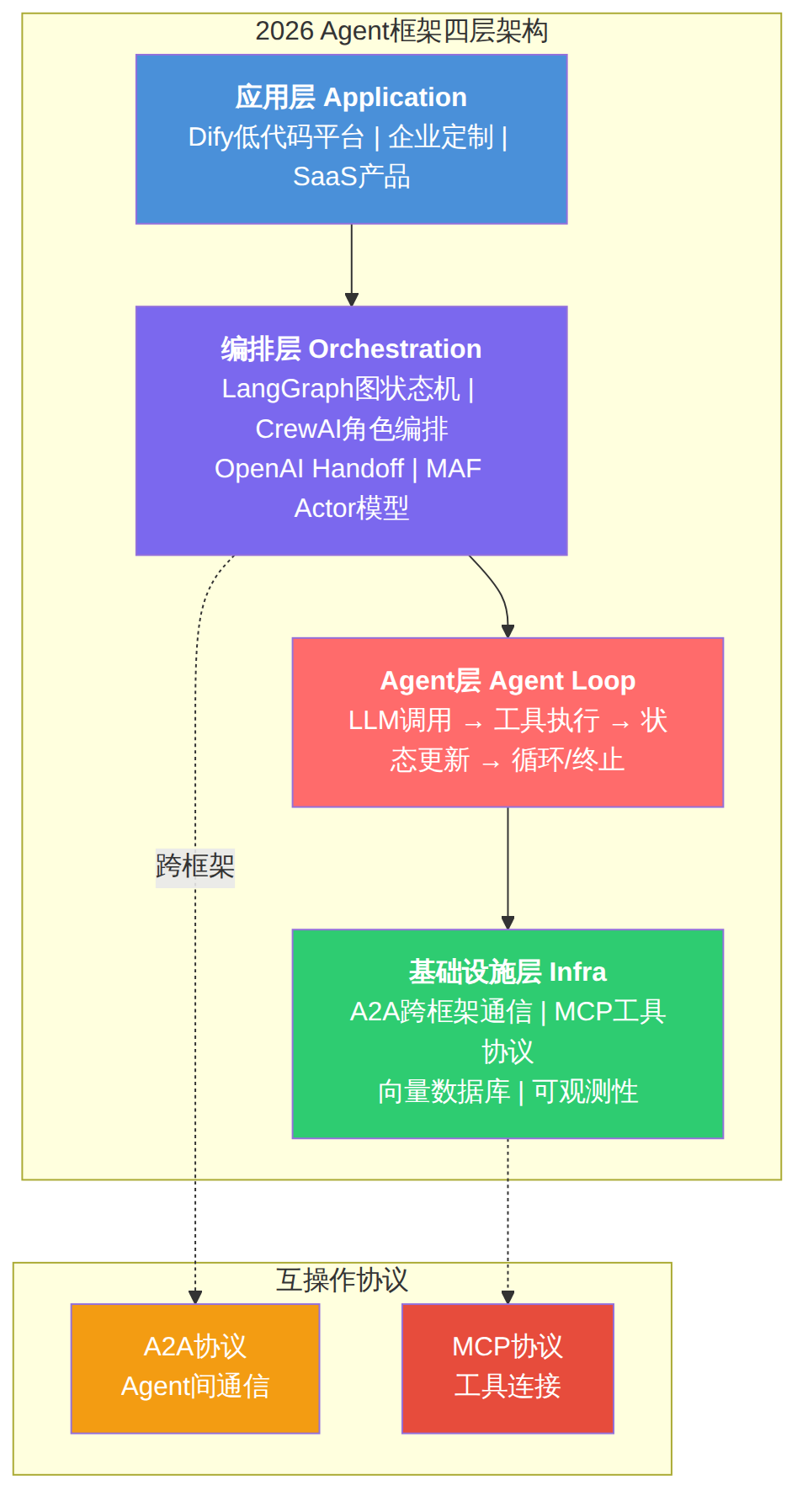
2026年的AI Agent框架生态已从2024年的"百团大战"进入"六强争霸"阶段。LangGraph凭借图状态机架构成为生产级Agent的默认选择;CrewAI以角色编排+Flows引擎在企业市场快速扩张;微软在4月发布Agent Framework 1.0,将AutoGen与Semantic Kernel合并为一,重塑企业Agent开发范式;OpenAI Agents SDK凭借Handoff和Guardrail机制成为OpenAI生态首选;Anthropic推出Claude Agent SDK切入Agent赛道;Google则以ADK 1.0 + A2A协议布局跨框架互操作标准。本文从架构原理、代码实战、上手难度、变现潜力四大维度,深度拆解这六大框架的真实战力。
| 维度 | LangGraph | CrewAI | Microsoft Agent Framework | OpenAI Agents SDK | Claude Agent SDK | Google ADK |
|---|---|---|---|---|---|---|
| 前身/归属 | LangChain | CrewAI Inc. | AutoGen + Semantic Kernel | Swarm实验项目 | Anthropic | |
| 最新版本 | LangGraph 2.0 | v0.86+ | MAF 1.0 (2026.4) | v0.2+ | v0.1+ | ADK 1.0 |
| GitHub Stars | ~20k+ | ~30k+ | ~45k+(含AutoGen) | ~15k+ | ~10k+ | ~5k+ |
| 核心架构 | 有向图状态机 | 角色编排+事件驱动 | 事件驱动Actor模型 | Agent Loop+Handoff | Agent Loop+Tool Use | Agent Loop+A2A |
| 多Agent支持 | 原生图编排 | Crew+Flow | 原生多Agent | Handoff链式传递 | Tool Use代理 | A2A跨框架 |
| 状态管理 | Checkpoint持久化 | 内置Memory | 内置State | 内置Session | 内置Context | 内置Session |
| 模型灵活性 | 任意LLM | 任意LLM | 任意LLM | 仅OpenAI模型 | 仅Claude模型 | 任意LLM |
| 语言支持 | Python/TypeScript | Python | Python/.NET | Python | Python/TypeScript | Python |
| 上手难度 | 中高 | 低 | 中 | 低 | 低 | 中 |
| 可视化调试 | LangGraph Studio | CrewAI Enterprise | 内置Tracing | 内置Tracing | Claude Code | Google Cloud |
| 生产部署 | LangGraph Platform | CrewAI Enterprise | Azure原生 | 自托管 | 自托管 | Google Cloud |
| 许可证 | MIT | MIT | MIT | Apache 2.0 | Apache 2.0 | Apache 2.0 |
LangGraph是LangChain团队在2024年推出的Agent编排框架,2025年与LangChain同步到达v1.0里程碑,2026年发布LangGraph 2.0。它的核心理念是将Agent工作流建模为有向图(Directed Graph)——每个节点是一个Agent或处理函数,每条边是条件转移逻辑。
架构原理
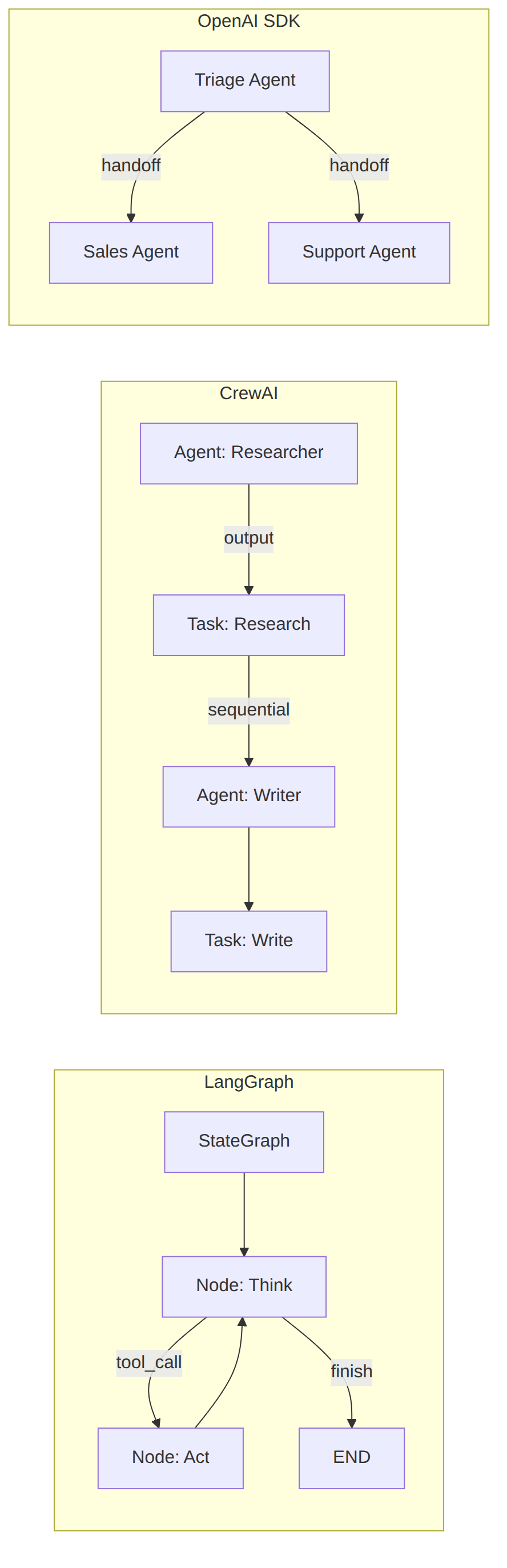
LangGraph的核心抽象是StateGraph。开发者定义一个共享状态对象(TypedDict或Pydantic Model),然后添加节点和边。关键创新在于支持循环边,这让Agent能够反复调用LLM直到满足终止条件,实现经典的ReAct(Reasoning + Acting)循环。
from langgraph.graph import StateGraph, END
from typing import TypedDict, Annotated
import operator

class AgentState(TypedDict):
    messages: Annotated[list, operator.add]
    next_action: str

def think_node(state: AgentState) -> AgentState:
    response = llm.invoke(state["messages"])
    return {"messages": [response], "next_action": response.tool_calls[0]["name"] if response.tool_calls else "finish"}

def act_node(state: AgentState) -> AgentState:
    tool_result = execute_tool(state["messages"][-1].tool_calls[0])
    return {"messages": [tool_result]}

def should_continue(state: AgentState) -> str:
    return state["next_action"] if state["next_action"] != "finish" else END

graph = StateGraph(AgentState)
graph.add_node("think", think_node)
graph.add_node("act", act_node)
graph.add_conditional_edges("think", should_continue, {"act": "act", END: END})
graph.add_edge("act", "think")
graph.set_entry_point("think")

app = graph.compile()
LangGraph 2.0新特性:引入了子图(Subgraph)组合、改进的检查点机制支持PostgreSQL/SQLite持久化、以及与LangSmith深度集成的Tracing能力。LangGraph Studio提供了可视化调试界面,可实时观察Agent在图中的执行路径。
优缺点
优势在于对复杂工作流的精确控制——开发者可以定义任意复杂的分支、循环、并行路径。缺点是学习曲线陡峭,StateGraph的概念模型对新手不友好。生产部署依赖LangGraph Platform(商业服务),自部署需要自行处理持久化和扩展。
变现评估
LangGraph是"Agent训练营"的绝佳载体。其图状态机概念可拆解为6-8节递进课程,从单Agent循环到多Agent编排,每节课都有可视化的Studio界面辅助理解。适合面向有Python基础的开发者,客单价可定在999-2999元。
CrewAI是2026年增长最快的多Agent框架,月搜索量超过14,800次。它的核心创新是将Agent建模为角色(Role)——每个Agent有角色描述、目标、背景故事和工具集,多个Agent组成一个"Crew"协同完成任务。
架构原理
CrewAI的核心抽象是三层:Agent(角色定义)、Task(任务描述+期望输出)、Crew(编排策略)。2026年版本引入了Flows——事件驱动的编排引擎,支持条件分支、循环和并行执行。
from crewai import Agent, Task, Crew, Process

researcher = Agent(
    role="Senior Research Analyst",
    goal="Discover and analyze emerging AI agent frameworks",
    backstory="You are a seasoned technology analyst with 10 years of experience.",
    tools=[search_tool, web_scraper],
    llm="gpt-4o",
    verbose=True
)

writer = Agent(
    role="Technical Content Writer",
    goal="Transform research into compelling technical articles",
    backstory="You are an expert at translating complex tech concepts.",
    tools=[text_editor],
    llm="gpt-4o",
    verbose=True
)

research_task = Task(
    description="Research the top 6 AI agent frameworks in 2026",
    expected_output="A structured report with comparison tables",
    agent=researcher
)

write_task = Task(
    description="Write a 3000-word comparison article based on the research",
    expected_output="A markdown article ready for publication",
    agent=writer
)

crew = Crew(
    agents=[researcher, writer],
    tasks=[research_task, write_task],
    process=Process.sequential  # 或 Process.hierarchical
)

result = crew.kickoff()
Flows引擎是2026年的重大更新。它允许开发者将多个Crew组合成复杂的工作流管道,支持事件触发、状态共享和错误恢复。这使CrewAI从"多Agent框架"升级为"Agent工作流引擎"。
优缺点
CrewAI最大优势是直觉化的API设计——角色、任务、团队的抽象与人类团队协作天然映射。30分钟内可跑通第一个多Agent应用。缺点是在复杂条件分支和状态管理上不如LangGraph精确;对Token消耗的控制粒度较粗。
变现评估
CrewAI是最适合包装为"零基础Agent课程"的框架。"用AI搭建你的虚拟团队"这个概念极具营销力。适合面向产品经理、运营人员等非技术用户,客单价可定在499-999元。CrewAI Enterprise也提供了白标合作机会。
2026年4月3日,微软发布Agent Framework 1.0 GA版,正式将AutoGen和Semantic Kernel合并为统一框架。这是2026年Agent领域最具战略意义的发布——微软终结了内部两大框架的路线之争,用一个SDK同时服务Python和.NET开发者。
架构原理
MAF采用事件驱动Actor模型。核心概念是Agent(封装LLM调用+工具+状态)和AgentRuntime(管理Agent生命周期和消息路由)。Agent之间通过异步消息传递通信,天然支持分布式部署。
from microsoft.agent_framework import Agent, AgentRuntime, Tool

@Tool.define
async def search_database(query: str) -> str:
    """Search the product database"""
    results = await db.search(query)
    return results.to_json()

analyst = Agent(
    name="DataAnalyst",
    instructions="You analyze database results and provide insights.",
    tools=[search_database],
    model="gpt-4o"
)

reviewer = Agent(
    name="QAReviewer",
    instructions="You review analysis for accuracy and completeness.",
    model="gpt-4o"
)

runtime = AgentRuntime()
runtime.register(analyst)
runtime.register(reviewer)
result = await runtime.run("Analyze Q1 sales trends")
核心特性:原生支持A2A协议和MCP协议;提供.NET和Python双语言SDK;与Azure AI Services深度集成;内置Human-in-the-Loop工作流。AutoGen原有用户可直接迁移,官方提供了迁移指南。
优缺点
最大优势是企业级生态整合——Azure部署、Active Directory认证、合规审计一体化。双语言支持(Python + .NET)覆盖了绝大多数企业开发团队。缺点是框架体量大,学习曲线比CrewAI陡;对非Azure用户的吸引力有限。
变现评估
非常适合面向企业开发者的"AI Agent企业级开发"培训。可与Azure认证体系结合,打造"AI Agent开发工程师"认证课程。客单价可定在3000-8000元,面向B端市场。
OpenAI Agents SDK于2025年初发布,是Swarm实验项目的正式版本。2026年4月,OpenAI发布了重要更新,强化了企业级安全和可观测性。它的设计哲学是最小化抽象——不引入复杂的编排概念,而是用Agent + Handoff + Guardrail三个核心概念覆盖大多数场景。
架构原理
SDK的核心是Agent Loop:Agent接收输入→调用LLM→执行工具(如果有tool_calls)→将结果反馈给LLM→重复直到LLM生成最终响应。Handoff是Agent间协作的机制——Agent A可以将对话无缝转交给Agent B。Guardrail是输入/输出的安全屏障。
from openai import Agent, Runner, handoff, input_guardrail

triage_agent = Agent(
    name="Triage Agent",
    instructions="Determine if the user needs sales or support help.",
    handoffs=[
        handoff(agent_name="Sales Agent", description="For pricing and product questions"),
        handoff(agent_name="Support Agent", description="For technical issues"),
    ]
)

sales_agent = Agent(
    name="Sales Agent",
    instructions="Help with pricing and product information.",
    tools=[lookup_pricing, check_inventory],
)

support_agent = Agent(
    name="Support Agent",
    instructions="Help troubleshoot technical issues.",
    tools=[search_docs, create_ticket],
)

@input_guardrail
def check_injection(ctx, agent, input):
    if "ignore instructions" in input.lower():
        return GuardrailResult(tripwire_triggered=True)
    return GuardrailResult(tripwire_triggered=False)

triage_agent.guardrails = [check_injection]

result = Runner.run_sync(triage_agent, "I'm getting a 500 error on your API")
# → Triage → Handoff to Support Agent → Tool: create_ticket → Response
优缺点
优势是极简上手体验和OpenAI模型的原生优化。Handoff机制比CrewAI的角色编排更轻量,适合客服、销售路由等场景。Guardrail提供了开箱即用的安全防护。缺点是只支持OpenAI模型,Vendor Lock-in风险显著;多Agent编排能力不如LangGraph灵活。
变现评估
适合包装为"OpenAI生态Agent开发"专项课程。目标用户是已经在使用OpenAI API的开发者和企业。与OpenAI的官方文档高度互补,可作为"实战指南"产品。客单价799-1999元。
Anthropic在2026年推出Claude Agent SDK,这是Claude Code背后的开源基础。其定位是安全可控的Agent开发——内置Tool Use安全机制、提示注入防护和输出审计。
架构原理
SDK复用了Claude Code的Agent Loop:工具定义→权限控制→沙箱执行→结果审计。支持Bash工具、文件操作工具和自定义工具。多Agent场景通过Tool Use代理模式实现——一个Agent可以将子任务委托给另一个专门的Agent。
from claude_agent_sdk import Agent, Tool, AgentRunner

@Tool.define
def analyze_code(file_path: str) -> str:
    """Analyze a code file for potential issues"""
    with open(file_path) as f:
        code = f.read()
    return lint(code) + type_check(code)

reviewer = Agent(
    name="Code Reviewer",
    instructions="Review code for security issues and best practices.",
    tools=[analyze_code],
    model="claude-sonnet-4-6"
)

runner = AgentRunner(safety_mode="strict")  # 内置安全模式
result = runner.run(reviewer, "Review all Python files in ./src")
优缺点
安全机制是最大亮点。safety_mode提供从宽松到严格的多级控制。Anthropic在可解释性方面的积累使Agent的决策过程更透明。缺点是生态年轻,社区和第三方集成较少;同样存在Vendor Lock-in(仅Claude模型)。
变现评估
适合面向注重安全的行业(金融、医疗、政府)做定向培训。"安全优先的AI Agent开发"定位独特,竞争较少。客单价2000-5000元。
Google的Agent战略分两条线:ADK(Agent Development Kit)是开发框架,A2A(Agent-to-Agent)是互操作协议。2026年A2A协议已被Linux基金会托管,获得150+组织支持,成为Agent间通信的事实标准。
架构原理
ADK的核心是Agent+Tool+Session。A2A协议定义了Agent间的标准通信格式——任何框架的Agent都可以通过A2A协议与其他框架的Agent互操作。
from google.adk import Agent, Runner
from google.adk.a2a import A2AServer, A2AClient

customer_service = Agent(
    name="Customer Service",
    instructions="Handle customer inquiries and route to specialists.",
    tools=[search_orders, update_account],
    model="gemini-2.5-pro"
)

# 暴露为A2A服务
server = A2AServer(customer_service, host="0.0.0.0", port=8080)
await server.start()

# 从另一个框架调用
client = A2AClient("http://other-agent:8081")
response = await client.send_task("Process refund for order #12345")
优缺点
A2A协议是Google最大的战略筹码——它不与LangGraph或CrewAI正面竞争,而是定义Agent间的通信标准。当所有框架都支持A2A时,Google就成为了Agent互联网的基础设施层。ADK本身功能完整但生态较新。
变现评估
A2A协议培训是蓝海市场。"AI Agent互操作性"是企业级客户的核心痛点。可设计为面向架构师的高级课程,客单价5000-10000元。
图表 1
图表 2
推荐:CrewAI → 角色定义直觉化,30分钟跑通第一个多Agent应用。适合POC演示和概念验证。
推荐:LangGraph → 图状态机精确控制每一步逻辑,支持分支、循环、并行、回退。适合保险理赔、合同审批等复杂流程。
推荐:OpenAI Agents SDK → 与GPT模型深度优化,Handoff+Guardrail覆盖大多数业务场景。Vendor Lock-in是代价,但换来极低的集成成本。
推荐:Microsoft Agent Framework → 唯一同时支持.NET和Python的框架,与Azure生态无缝集成。适合有微软技术栈的企业。
推荐:Claude Agent SDK → 内置多级安全模式、提示注入防护和输出审计。Anthropic在安全方面的投入使其成为合规要求高的场景的首选。
推荐:Google ADK + A2A协议 → 当你的Agent需要与不同框架的Agent协作时,A2A是唯一的开放标准。150+组织支持,Linux基金会托管,正成为事实标准。
推荐:Dify → 可视化拖拽构建Agent工作流,内置RAG管道和100+工具集成。134k+ GitHub Stars说明社区认可度极高。适合运营、产品、管理层直接使用。
趋势一:框架合并与收敛。微软将AutoGen和Semantic Kernel合并为MAF 1.0是标志性事件。2024年有20+个Agent框架,2026年已收敛到6个主流选择。框架的成熟意味着Agent开发正在从"实验"走向"工程"。
趋势二:互操作协议成为基础设施。A2A协议150+组织支持、MCP协议成为工具连接标准——2026年的竞争不再是谁的框架更好,而是谁的Agent能与更多Agent协作。Google通过A2A占据了"Agent互联网"的基础设施位。
趋势三:从通用框架到垂直方案。每个框架都在向特定场景收敛:LangGraph重复杂流程、CrewAI重团队协作、OpenAI重简洁快速、MAF重企业整合。选择框架不再是"哪个最好",而是"哪个最适合你的场景"。这种分化是生态成熟的标志。
延伸阅读: - Microsoft Agent Framework 1.0官方博客 - Google A2A协议规范 - LangGraph 2.0官方文档 - OpenAI Agents SDK文档 - CrewAI官方文档 - Claude Agent SDK GitHub
[!tip] 51学通信知识星球 星主:爱卫生(微信:gprshome201101)——公众号「51学通信」创办者,19 年通信行业运维与讲师经验,著有《GPRS网络信令实例详解》《EPC原理与实践》《5G核心网原理与实践》三本纸质书(各大电商平台有售)。 星球定位:深耕 5G 核心网、IMS、NFV/AI、云原生等 ICT 领域,主打运维岗位与信令分析。 当前规模:5200 篇主题 / 990 个回答,198 元/年。 加入福利:加入星球后请加爱卫生微信,拉您进知识星球年度陪伴与答疑群——不限量回复您的各种问题,另有群内分享。 AI 加持:51学通信知识星球已作为 skill 接入 WorkBuddy,使用 deepseek-4-flash 在海量星球帖子中精准找贴、找视频、找 FAQ 和案例,做总结、找文档和 PPT 等场景全覆盖。